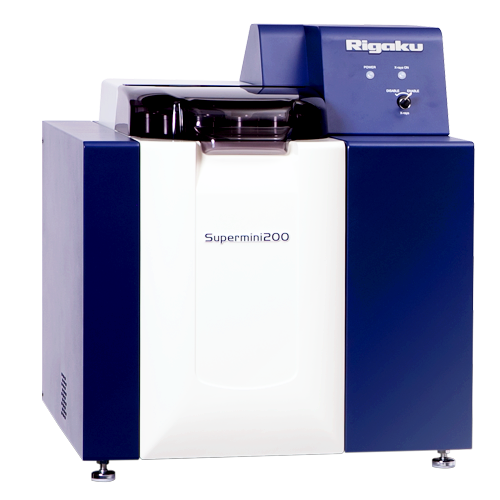
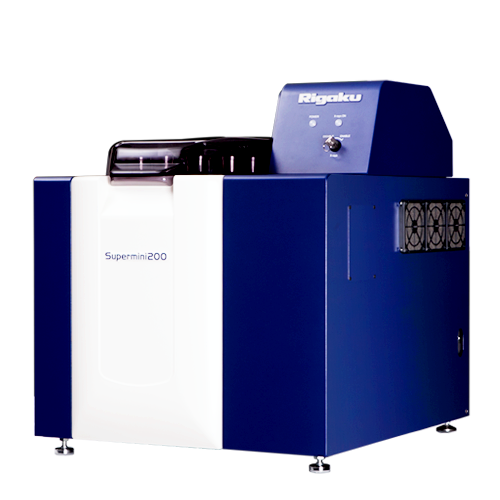
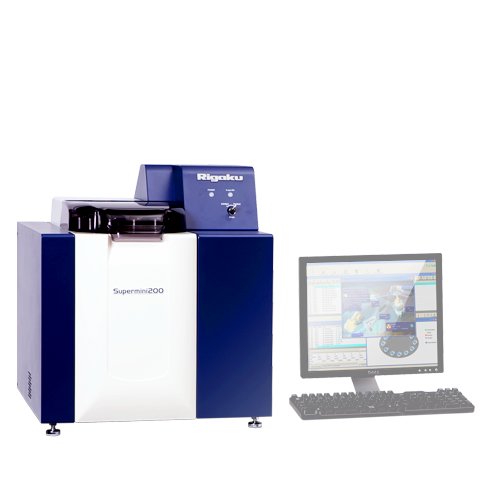
Supermini200
Compact wavelength dispersive X-Ray fluorescence (WDXRF) spectrometer for precise elemental analysis.
- High-resolution wavelength dispersive X-ray fluorescence.
- Suitable for a wide range of sample types.
- User-friendly operation with advanced software.
- Low maintenance and high reliability.
- Compliant with ISO and other international standards.
Key Features
 Supermini200 is fully compliant with ASTM D2622, ASTM D6443, providing both standard method and refined methodology.
Supermini200 / WDXRF elemental analysis
Benchtop WDXRF.
Changes everything.
Powerful, well-established elemental analysis
Wavelength dispersive X-ray fluorescence (WDXRF) is one of the most powerful and well-established techniques for elemental analysis. It has several advantages, including light element sensitivity, exceptional elemental resolving power, and low limits of detection. Historical drawbacks of the WDXRF technique have been that such instruments are typically large, expensive, and require special utilities. With a size that is 1/4 that of traditional WDXRF units and a price that is approximately 1/2 of floor-standing units, the Supermini200 benchtop spectrometer changes everything.
The X-ray fluorescence experiment
Expose. Emit.
Measure.
Every element leaves its own fluorescent signature.
The X-ray fluorescence (XRF) experiment begins with exposing a sample to high-energy photons from an X-ray tube, which induces transitions of electrons between atomic orbitals and results in the emission of fluorescent photons.
From photons to elemental composition.
By measuring the energy and intensity (count rate) of these photons, qualitative and quantitative information about the elemental composition is obtained.
The XRF experiment
- High-energy photons
- Electron transitions
- Fluorescent photons
Precision + Range
One tube.
Oxygen through uranium.
A 200 W palladium-anode X-ray tube runs at 50 kV, 4 mA, exciting elements from oxygen through uranium. A programmable beam filter (Zr standard, Al optional) and a three-position crystal changer (LiF(200) and PET standard, RX25 and Ge optional) feed a flow proportional counter and scintillation counter, covering samples up to 44 mm in diameter and 33 mm tall on a 12-position auto-sampler with a 30 rpm sample spinner.
Runs without special utilities.
A rotary vacuum pump replaces the cooling water, plumbing, and external chiller that larger WDXRF systems typically require.
At a glance
- Vacuum standard, helium optional
- 15–28°C, <75% RH
- Rotary vacuum pump, no chiller needed
- 100 kg (220 lbs)
Measurement quality
Precision depends on
two primary metrics.
- 01
Measurement Quality
Usually judged as precision (repeatability), and a function of many factors.
- 02
Elemental Peak Resolution
One of the two primary metrics.
- 03
Photon Counting Rate
One of the two primary metrics.
Specs
| Test Method Compliance | ASTM D2622, ASTM D6443 | |
| Elemental coverage | Oxygen (O) through uranium (U) | |
| X-ray tube | Pd target | |
| X-ray power | 200 W | |
| Generator | 50 kV, 4 mA | |
| Beam filter | Programmable Zr standard Al optional |
|
| Crystals | LiF(200) and PET standard RX25 and Ge optional |
|
| Detectors | Flow proportional counter Scintillation counter |
|
| Sample size | 44 mm diameter maximum 33 mm height maximum |
|
| Auto-sampler | 12-position turret | |
| Sample spinner | Standard, 30 rpm | |
| Atmosphere | Vacuum standard Helium optional |
|
| Vacuum pump | Rotary pump | |
| Helium flush | 15 – 65 PSIG, 0.5 l/min | |
| Environment | 15 – 28°C temperature <75% relative humidity |
|
| Operating system Windows® 7 | Options: SQX software with FP Matching library SQX scatter FP method Fused bead correction Line Overlap Correction using Theoretical Intensities (LOCTI) Quant scatter FP |
|
| Power requirements | 100 – 120V (50/60 Hz) 15A or 200 – 240V (50/60 Hz) 10A | |
| Weight | 100 kg (220 lbs) | |
| Dimension | 58x68x67 cm (22x27x26 inches) | |
| Shipping weight | ||
| Dimension with crate |